Beekeeping Gear
Apivar® Bee Hive Strips – Amitraz 500mg Varroa Mite Treatment | APVMA Permit PER95905 | Trusted Synthetic Miticide for Australian Beekeepers
Apivar® Bee Hive Strips – Amitraz 500mg Varroa Mite Treatment | APVMA Permit PER95905 | Trusted Synthetic Miticide for Australian Beekeepers
Couldn't load pickup availability
Long-Lasting Slow-Release Amitraz Strips for Reliable Varroa Control — Up to 99% Mite Knockdown, Zero Honey Withholding After Removal
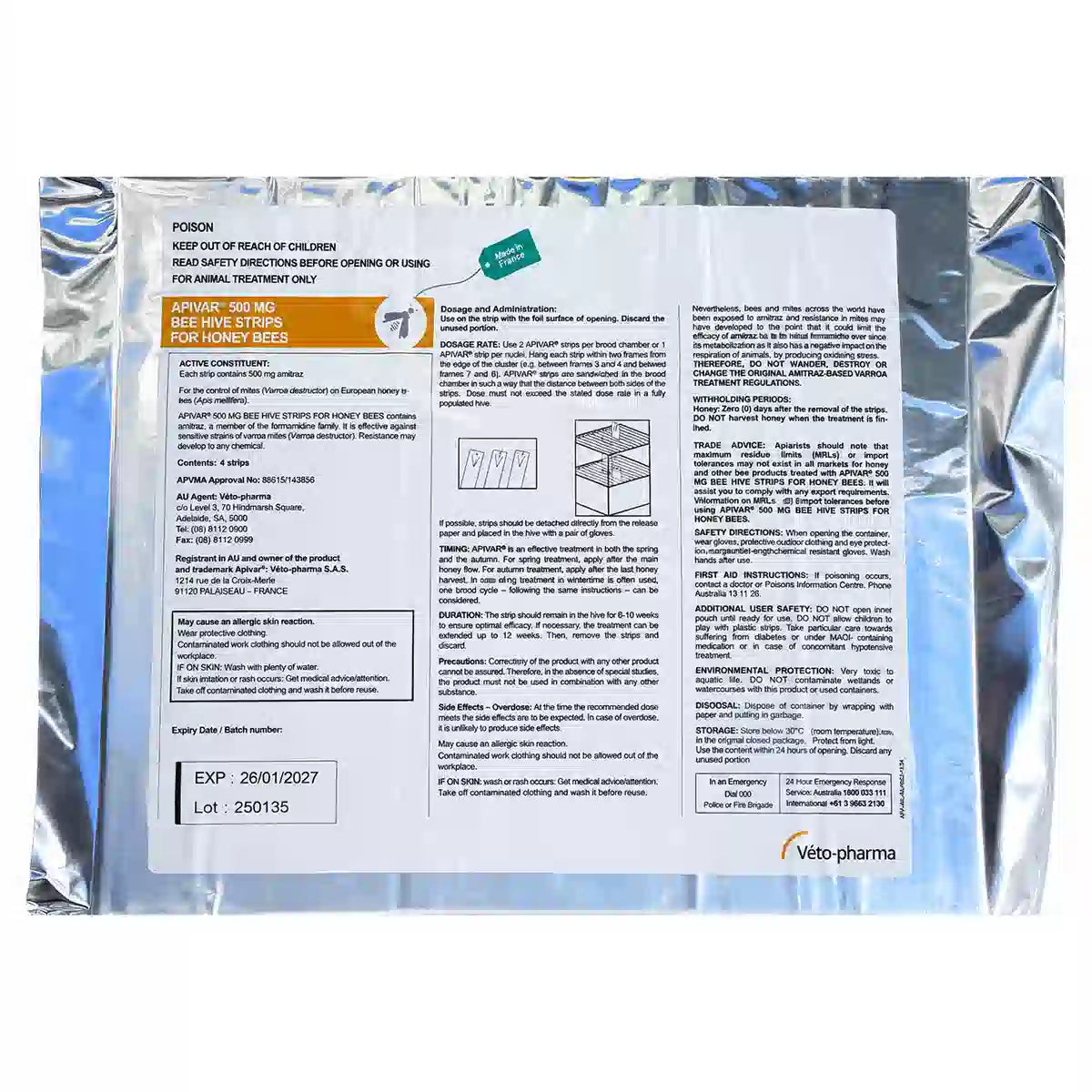
Need a proven, professional Varroa mite treatment for your apiary? Apivar® Bee Hive Strips are an APVMA-permitted synthetic miticide (Permit PER95905) containing amitraz 500mg per strip — the most widely used chemical Varroa treatment in the world. Trusted by beekeepers globally for over 15 years, Apivar® delivers reliable, long-lasting Varroa control in any weather, with zero honey withholding period after strip removal — a significant advantage for commercial honey producers.
What is Apivar® and how does it work?
Apivar® is a slow-release contact miticide that uses amitraz — a synthetic amidine — embedded in a polymer plastic strip. As bees walk past the strips inside the brood chamber, they pick up tiny amounts of amitraz and distribute it through the colony. Amitraz excites and paralyses Varroa mites, causing them to lose grip on the bees and fall to the bottom of the hive, where they die. Just one application can deliver up to 99% Varroa knockdown over a 6–10 week treatment cycle.
Key Features and Benefits
- APVMA Permit PER95905 — fully permitted for use in Australia
- Up to 99% Varroa knockdown with proper application
- 500mg amitraz per strip — released slowly over 6–10 weeks
- Single application per cycle — treat once in spring, once in autumn
- Reliable in any weather — works in cold, hot, humid, or windy conditions
- Long treatment window — 6 to 10 weeks of continuous mite control
- Zero honey withholding period — honey can be harvested immediately after strip removal (Australian permit advantage)
- Easy application — flexible polymer strip hangs between brood frames; even works with gloves on
- Trusted globally — over 15 years of proven results worldwide
How to use Apivar® Strips
Always follow the APVMA Permit PER95905 instructions in full. As a general guide:
- Dose: 2 strips per single brood box | 4 strips per double brood box | 1 strip per 5-frame nuc
- Placement: Hang strips between frames in the central brood area where bees are most active
- Treatment time: Minimum 6 weeks, maximum 10 weeks (then remove)
- Timing: Spring (before honey flow) and autumn (after harvest, before winter bees emerge)
- Honey supers OFF: Do NOT use Apivar® while honey supers are present. DO NOT harvest honey when strips are in place
- DO NOT cut strips or repackage them
- DO NOT reuse strips — used strips must be disposed of safely
- Do not use Apivar® for two consecutive treatment cycles — rotate with a different mode of action
Honey withholding — a key advantage of Apivar®
Unlike some Varroa treatments, Apivar® has a zero-day honey withholding period after strip removal. This means once the strips are removed, honey supers can be added back immediately without waiting. This is a major advantage for beekeepers, timing treatments around honey flows.
Important: do not extract honey from the brood chamber after Apivar® treatment, and never make honeycomb, propolis, or royal jelly from treated brood available for human consumption.
Why Rotation Matters
Apivar® and Apitraz both contain amitraz and share the same mode of action. To prevent Varroa resistance:
- Do not rotate Apivar® with Apitraz (same active ingredient)
-
Do rotate Apivar® with treatments from a different chemical class, such as:
- Bayvarol® / Apistan® (synthetic pyrethroids) — but not Bayvarol and Apistan together either
- Formic Pro (formic acid)
- Api-Bioxal (oxalic acid)
Rotation between chemical classes keeps Varroa from developing resistance and protects the long-term health of the entire Australian beekeeping industry.
Mandatory record keeping (APVMA legal requirement)
By purchasing Apivar®, you agree to maintain treatment records for a minimum of 2 years, including:
- Date of treatment
- Location of hives treated
- Total amount of product used
- Names and addresses of persons performing the treatment
Records must be available to the APVMA or your state department on request.
Safety and storage
- Schedule 5 — CAUTION chemical
- Wear gauntlet-length chemical-resistant gloves when handling and removing strips
- Wash your hands thoroughly after handling
- Avoid contact with skin — Amitraz is toxic by skin absorption
- Keep away from children, pets, and food/feed
- Store in a cool, dry place in the original packaging
- Open inner pouch only when ready for use — protect from light
- Discard any unused strips within 24 hours of opening
- Very toxic to aquatic life — never dispose of strips in waterways
- Take care if you have diabetes or are on MAOI/hypertensive medications
- For poisoning, call Poisons Information Centre on 13 11 26
Important shipping note
Apivar® can currently only be shipped to NSW, ACT, VIC, and QLD under the current APVMA permit. Please check eligibility at checkout or contact us for guidance.
Trusted Australian beekeeping supplier since 2016
Beekeeping Gear has been Australia’s trusted source for APVMA-permitted Varroa management products since 2016. Visit our Sydney showroom in Granville (next to Clyde train station) or our QLD location in Meadowbrook for hands-on advice, or order online with fast Australia-wide shipping.
Pair with our matching products
Bayvarol® strips, Api-Bioxal oxalic acid, Formic Pro, InstantVap vaporizers, Varroa monitoring tools, and protective gloves — for a complete integrated pest management toolkit.
Order your Apivar® Bee Hive Strips today — and bring proven, APVMA-permitted Varroa control to your apiary.