Beekeeping Gear
Gabled Hive - Painted, Wax-Dipped Mesh Bottom Board
Gabled Hive - Painted, Wax-Dipped Mesh Bottom Board
Couldn't load pickup availability
A Complete Two-Level Hive With a Roof Built for Rain
Most beehives sit under a flat telescopic lid and do fine. But if you’ve ever watched a flat roof shed rain poorly, or sat inside a shed on a hot day and felt the heat radiating down from a low ceiling, you’ll understand why a gabled roof is a different experience altogether. Rain sheds faster off a pitched roof. Hot air rises and escapes through the peak rather than sitting directly above the colony. It’s a time-tested design that works and it looks better doing so.
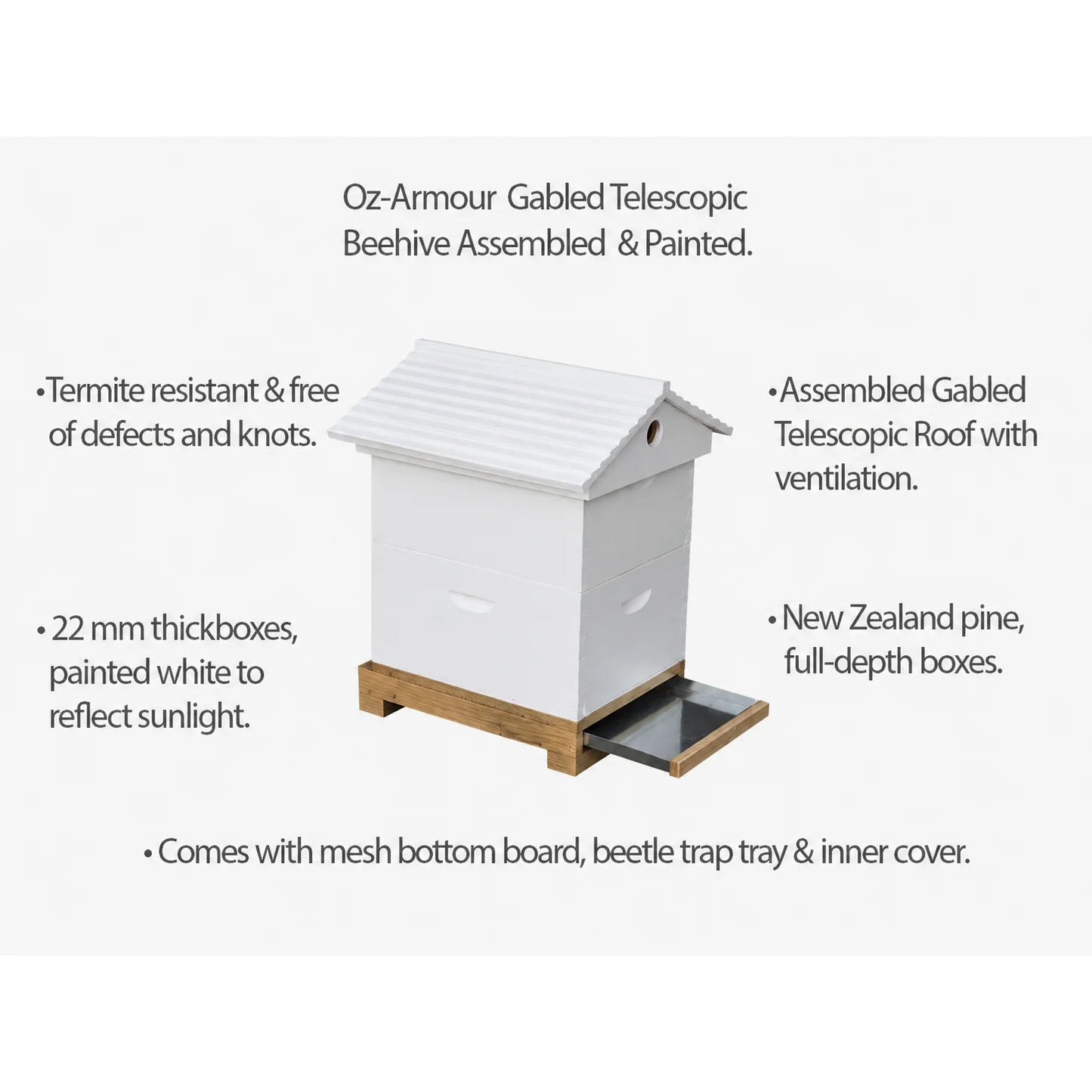
This OZ ARMOUR Gabled Telescopic Beehive arrives fully assembled and painted, complete with two full-depth boxes, a ventilated gabled roof, an inner cover, a galvanised queen excluder, and an upgraded wax-dipped mesh bottom board with beetle trap. At $259.99, available in 8-frame (16 frames) or 10-frame (20 frames) with optional wax-embedded frames, it’s a complete hive that’s ready to work from the day it arrives.
The Gabled Roof: More Than Just Good Looks
The gabled telescopic roof is what makes this hive stand apart from a standard flat-lid setup, and it earns its place on both practical and visual grounds. The pitched peak sheds rain cleanly off both sides, which means water runs away from the hive quickly rather than pooling on a flat surface and working its way into the timber at the edges over time. In parts of Australia that see heavy summer storms or persistent winter rain, that difference in water management adds years to the life of your hive.
The ventilated design allows hot air to rise and escape through the roof peak rather than sitting directly above the top box and radiating heat down into the colony. On a hot Australian summer day, that ventilation means a cooler, more comfortable hive and bees that are spending less energy fanning and more energy foraging and producing. The roof also adds a distinctive look that stands out in an apiary or garden setting, which is something beekeepers who take pride in their setup tend to appreciate.
22mm NZ Pine: Built for the Long Run
The boxes are made from 22mm New Zealand pine, 3mm thicker than the standard 19mm used in most imported hives. Thicker walls mean better insulation during Australian temperature extremes, greater resistance to warping and cracking during wet winters and dry summers, and a hive that maintains its structural integrity for 15 to 20 years with basic care. The exterior is painted white, UV-resistant and water-resistant which reflects summer heat and protects the timber from moisture year-round. The interior is left in its natural, unpainted pine, which is the surface bees settle into most readily.
Wax-Dipped Mesh Bottom Board: Beetle and Varroa Control
The wax-dipped mesh bottom board is one of the most important features this hive comes with and it does two jobs that a standard solid bottom board simply cannot.
The first is small hive beetle control. Bees naturally herd beetles toward the floor of the hive, and the stainless-mesh bottom board, wax-dipped, lets them fall through into the removable tray below, where they can’t climb back out. Fill the tray with diatomaceous earth, a natural, chemical-free powder and you have passive, continuous beetle management running every day without any effort from you. In Queensland, New South Wales, and other parts of Australia, where small hive beetle pressure is significant, this is a meaningful advantage over a solid board.
The second is varroa monitoring. With varroa now established across much of Australia, monitoring mite levels is an essential part of responsible hive management. Varroa mites that drop off bees during natural grooming or after a treatment fall straight through the wax-dipped mesh into the removable tray below and cannot climb back up. Slide the tray in with a light coating of petroleum jelly or vegetable oil, leave it for 24 to 48 hours, and count the natural mite drop. That gives you a clear picture of your colony’s mite load without disturbing a single frame or needing any additional equipment. The wax-dipped mesh bottom board turns varroa monitoring into a simple, routine part of hive management.
The wax-dipping treatment itself means the board needs no painting, no recoating, and no seasonal maintenance. Natural beeswax penetrates the timber fibres from the inside out, permanently sealing the wood against moisture. It lasts, it’s completely natural, and bees are comfortable with it from the moment they move in.
Inner Cover and Queen Excluder Included
The inner cover sits between the top box and the gabled roof, providing a secondary layer of insulation and climate control that helps the colony manage temperature more efficiently through both summer heat and winter cold. It also makes removing the roof much cleaner at inspection time, the bees propolise the inner cover rather than the roof itself. Hence, the roof lifts off easily without disturbing the colony.
The galvanised queen excluder sits between the brood boxes and the honey super, allowing worker bees to move freely while keeping the queen confined to the brood area. The result is clean honey supers at harvest time, no brood mixed in with your capped frames, no complications, just honey.
Two Full-Depth Boxes: Room to Build
Two full-depth boxes give your colony the space it needs to establish a strong brood nest and begin storing honey without needing to add equipment mid-season. For a new colony going in strong, whether that’s a nucleus, a package, or a caught swarm, two boxes is a solid starting point that can be expanded upward with a honey super when the colony is ready, and the frames are mostly drawn.
8-Frame or 10-Frame: Which to Choose
The 10-frame version includes 20 full-depth frames and is the Australian standard. it offers maximum honey capacity and is compatible with virtually all Langstroth accessories. The 8-frame includes 16 frames and is lighter when full, which suits beekeepers who prefer easier handling or are working in tighter spaces. Both configurations include the same gabled roof, inner cover, queen excluder, and wax-dipped mesh bottom board.
Wax-Embedded Frames: Optional at Checkout
At checkout, you can choose the hive without frames if you already have stock on hand, or add a full set of Australian-made wax-embedded frames, 20 frames for the 10-frame version, 16 for the 8-frame, ready for the colony to start drawing comb immediately. For most new beekeepers and anyone who values their time, the wax-embedded option is the better choice. Wiring and embedding frames is a multi-hour job that requires specific tools and practice, having them ready means you can install your bees and step back without delay.
Specifications
- Brand: OZ ARMOUR trusted globally since 2018
- Configuration: 2 x full-depth boxes fully assembled and painted white
- Timber: 22mm New Zealand pine, knot-free, dimensionally stable
- Exterior: UV-resistant, water-resistant white paint
- Interior: Unpainted natural NZ pine, bee-friendly
- Roof: Gabled telescopic with ventilation, superior rain shedding and airflow
- Inner cover: Included
- Queen excluder: Galvanised included
- Bottom board: Wax-dipped mesh with beetle trap, no painting required, maintenance-free
- Beetle control: Removable tray, use with diatomaceous earth
- Varroa monitoring: Removable tray for natural mite drop counts
- Frame options: Without frames OR with wax-embedded frames (choose at checkout)
- Frame count: 20 frames (10-frame) OR 16 frames (8-frame)
- Sizes: 8-frame or 10-frame Langstroth
- Lifespan: 15-20+ years with basic care
- Rating: 4.9/5 stars